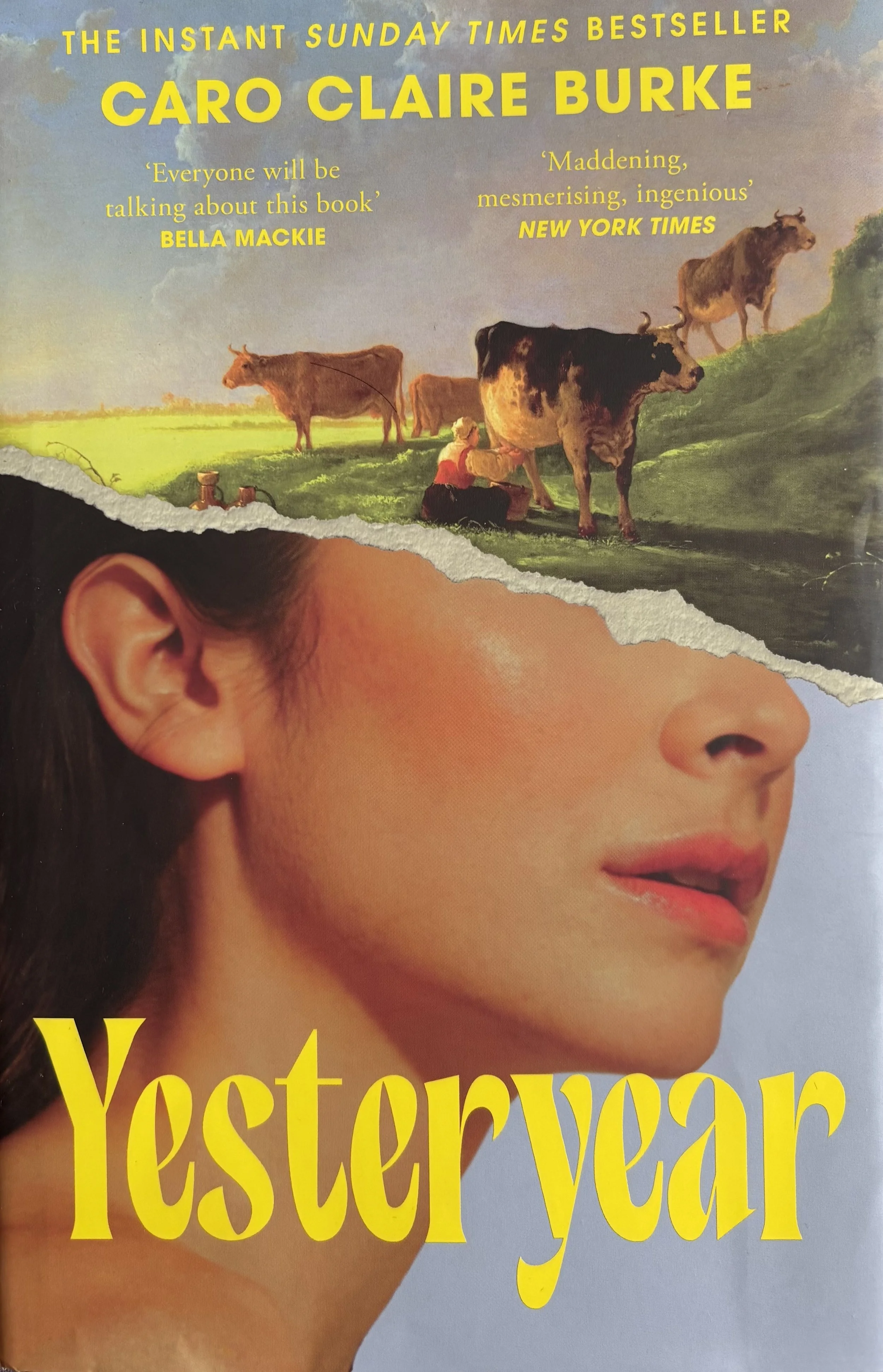
Yesteryear by Caro claire burke book review
***SPOILER warning***
DUH…
Follow us on Insta!!
Caro Claire Burke’s novel Yesteryear is about a 32-year-old Instagram influencer Natalie Heller Mills who has built an 8 million following by pretending to live a rustic, traditional lifestyle. Natalie curates an idealized image of an Idaho ranch with her cowboy husband and six kids whilst hiding industrial kitchens, nannies, and a production crew that work behind the scenes. Suddenly, she wakes up in a parallel, primitive version of her life. Her home, her husband, her children—they’re all familiar, but something’s off. Electricity is replaced by a sputtering fire and hand-washing clothes till her fingers bleed. The novel is a satire on influence of social media and the tradwife movement.
Natalie is not a likeable character as she is judgemental, self-righteous, egotistical and completely unaware of other people needs or wants. I don’t buy into anything she stands for. Yet, the girl was funny I can’t lie. So, even though Natalie is an unlikeable character she is still a very readable protagonist. That is purely down to Burkes excellent writing. The main themes of Yesteryear are the importance of tradition, faith and womanhood and how they cohabitate with fame and success for women. Natalie is a walking contradiction. She parades the traditional values of a loving, ever-serving wife but she is extremely ambitious, cold-hearted and selfish woman. I thought this would explain why the narrative structure of the books was so miss match. The first chapter of the book is one day, the last chapter of the book is another, and the middle parts are everything in between told in a continuous stream of conscience. It isn’t until the end of the book to we realise that Natalie has had either psychotic break or some sort of dementia and that explains the confusing native structure. We learn that after an incident between Natalie and her producer after she finds out she has been sleeping with her husband causes so much controversy that the entire family has to go off the grid. She hasn’t timed travelled to the past; she’s just lost time in her confusion.
I think what makes Natalie a readable character even though she is unlikeable is because no one is likeable in the book. Everyone is terrible, no one more so than the men. It’s almost facile to blame all of this on Natalie, when she was aided, abetted, and encouraged by her husband, her father-in-law, and her sons, at different points across the story. The worst person is her husband. How can Natalie be the traditional wife she wants to be when she has a lazy and useless husband? This is Caleb’s story development:
Caleb (who couldn’t get it hard for his wife) —> porn addict Caleb —> manosphere Caleb —> affair Caleb —> Old Caleb hits his wife and has become the “traditional” man Natalie always wanted only to find out he has gotten his older sons to buy them all the stuff they needed because he couldn’t (or wouldn’t) build the skills to live of the grid.
In a way you could see why Natalie was never enamoured by him.
I really liked this book and I think it all came together in the end. To me this was a 5 out of 5 read.