The Vegetarian by Han Kang book review
***Spoiler Warning***
Duh…
Follow us on Instagram
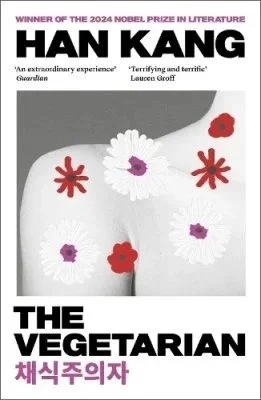
The Vegetarian by Han Kang is a surreal Korean novel that highlights the societal pressures and violent desire that are deep within us as seen through the running theme of perceived control and human cruelty. Yeong-hye, who at the beginning is seen as a perfectly ordinary woman until one night, Yeong-hye has an awful dream that affected her temperament which resulted in her refusing to eat meat from then on. This refusal of eating meat slowly escalates to Yeong-hye reducing the amount she eats all together. Her body thins and she becomes a skeleton of herself which then triggers violent family conflicts. The novel is split up into three short- but related- stories that focus on Yeong-hye’s mental deterioration but from the point of view of people close to Yeong-hye but never from Yeong-hye’s perspective. This provides a distance from the reader to the presuming mentally unwell women.
The first story is called The Vegetarian and is told in first person narrative from the perspective of Mr. Cheong, Yeong-hye’s husband. Mr. Cheong considers his wife to be “completely unremarkable in any way” and that he wasn’t even attracted to her when they first met. Mr. Cheong is content with just meandering through life and succeed at being completely average. That is why he married Yeong-hye, as he thought that she would be a dutiful wife that would not want or expect any more than the bare minimum. Several years of an ordinary marriage, Mr. Cheong got just that. Until one night when he wakes to his wife disposing of all the meat that they had in the house like she was in a frenzy. He demanded to know what Yeong-hye was doing but all she could reply was “I had a dream”. Mr. Cheong tried to rationalise his wife’s new diet but after an awkward meal with his colleagues, and Young-hye rapid decline in weight, Mr. Cheong could not stand it anymore and scheduled an intervention with his wife’s family. The decrease levels of sex lead to Mr. Cheong to repeatedly rape his wife. This section focuses on the control- or lack of- the husband has over his wife. Yeong-hye’s choice of diet is seen an act of rebellion against her husband and normal society. However, I see it as a women trying to gain a small amount of control, and in response society sees her as crazy. Therefore, she becomes crazy. This is also seen whilst the whole family is around the dinner table. Yeong-hye’s Vietnam war veteran father force feeds her a bit of pork. She spits it out and, in an act to gain control, she slices her wrist open. She was taking a stand against her own father- someone above all else should be respected and honoured. The story ends with Yeong-hye leaving the hospital and reveals to have bird in her palm with a “predator’s bite” in it and she asks, “have I done something wrong?”. It’s such as an earie end to the first story as why was it so awful for her to never eat meat. Society believed her to be insane, so she became insane.
The second story is called Mongolian Mark and is told from the perspective of the unnamed husband of Yeong-hye’s sister In-hye. He is a video artist who is conflicted with the image of two people having sex whilst being covered in flowers, as he shamed by the images. At the same time, he becomes fixating with his sister-in-law once he learns that she has a Mongolian mark in the shape of a flower petal. He goes to her apartment and asks her to model for him, and she agrees. The brother-in-law covers Yeong-hye’s body in painted flowers with the hope that this would dispel all his desires. However, he now desires to touch her with more than his paintbrush. As a way around this, he manages to get his arty friend to join in with making a simulating sex video with Yeong-hye. The imitation of sex is not enough for Yeong-hye’s brother-in-law and asks them to do it for real- disgusted his friend leaves. Yeong-hye admits that she was turned on but only because the man was painted in flowers. So, her brother-in-law then paints himself in flowers and goes to Yeong-hye apartment where he forces himself on her. This chapter focuses on desire and the contrasts between how men and women feel desire. Yeong-hye’s brother-in-law desire is centred around the exotic, free and forbidden. In comparison, Yeong-hye’s desire is sparked when the man is covered in delicate, feminine flowers. It signifies the disparity between male and female desire.
The last story is called Flaming Trees and is told though the perspective of In-hye, as she is the only member of the family left who is willing to support her sister. She is separated from her husband after the events in the previous chapter. She is left to take care of her son and her deteriorating sister who has been committed into a mental hospital for anorexia nervosa and schizophrenia. Yeong-hye is behaving more plant like, giving into her psychosis. One-time she escaped the hospital and is found standing among the trees “soaked with rain as if she herself were on of the glistening trees”. In-hye continues to visit her sister and try and get her to eat with no avail. Yeong-hye has given up on food all together. As the story progresses, we see In-hye depression deepening as she tries to survive the pressures of a life she has been forced because of other peoples- mainly men- actions. When In-hye witnesses the doctors force-feeding Yeong-hye and threatens to sedate her to prevent her from vomiting. Something in In-hye snaps and she bites the nurse and grabs her sister. In-hye and Yeong-hye are driven to a different hospital by ambulance. In-hye observes trees as they pass by, which is a hint at the possible inheritance of similar vegetal psyche, which affects her as well. This story provides a cyclical structure to the novel as it repeats the same themes featured in the first story where women are driven to madness or are seen as mad if they seek freedom from society pressure.
This novel was a fascinating read that delicately portrayed the horrors of womanhood. I give it 4.5/5.