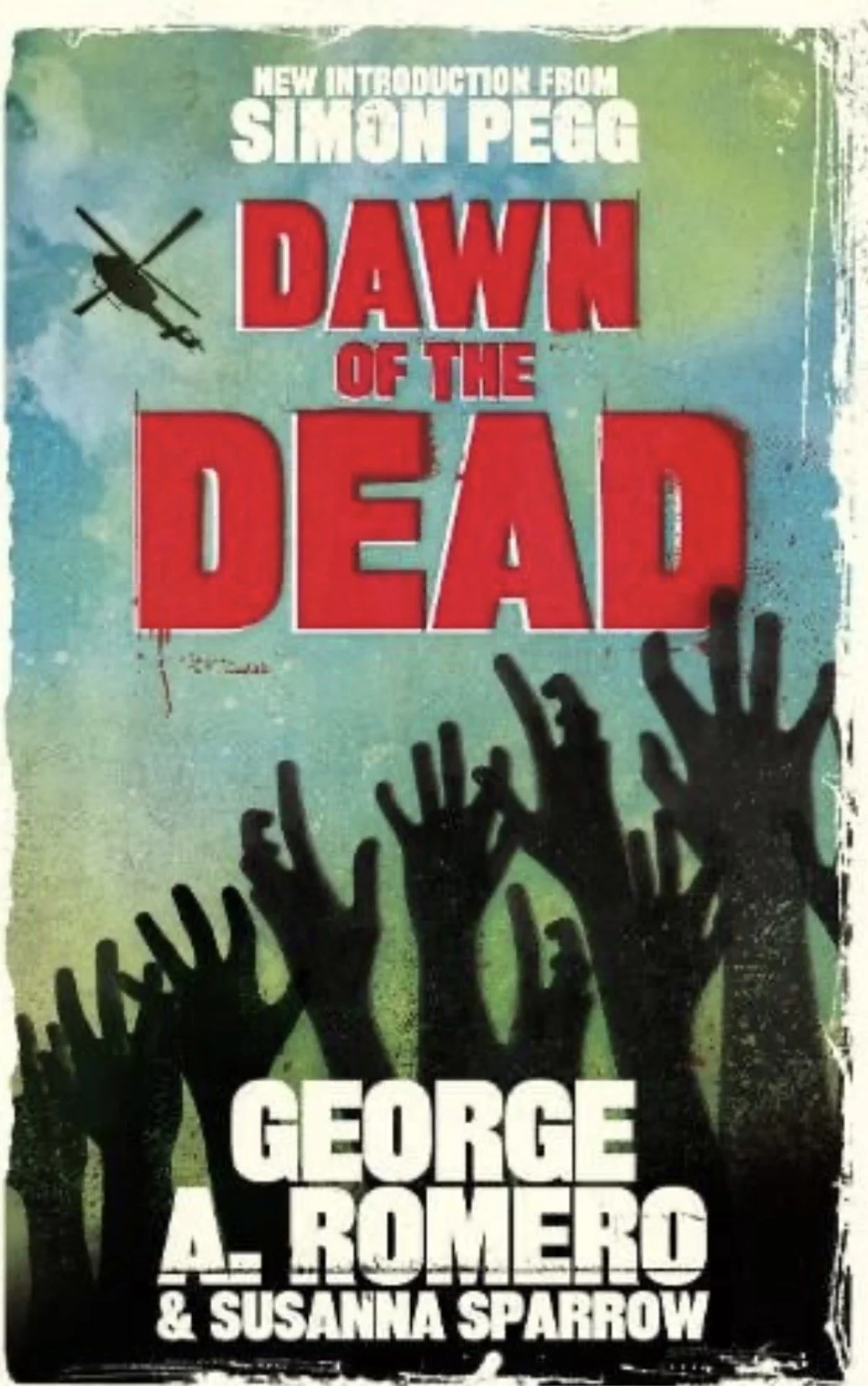
Dawn of the Dead by George A. romeor and Susanna sparrow
Book Review
*** Spoiler Warning ***
DUH…
Follow us on Insta!!
The Dawn of the Dead is a 1978 horror novelization of George A. Romero’s classic zombie film and is co-written by Romero and Susanna Sparrow. Follow the success of the second zombie film in Romero’s series, the book (more or less) follows the same story.
The story begins in the studios of W-Gon TV in Philadelphia during a zombie apocalypse.
Whilst debates about the apocalypse rage on air, assistant manager Francine Parker tries to get an updated list of rescue stations posted on air against the wishes of her boss. After several arguments break out and everything starts to fall into chaos, Francine’s boyfriend Steve tells her about a plan to use the traffic helicopter to escape. Meanwhile, Steve’s friend Roger is waiting outside of an apartment block. Roger is a member of a S.W.A.T team, aided by the military, who want to evacuate the residents of the tower to a rescue station. The people in the tower don’t want to leave, and it isn’t long before a gunfight breaks out between them and the authorities. In addition to this, many of the tower’s dead also begin to rise from the grave as flesh-eating zombies. During the violent chaos, a trooper called Peter saves Roger’s life and – realising that the fight against the dead is futile – Roger tells Peter about Steve’s plan to steal a helicopter and get the hell out of town. So, both men decide to go AWOL.
The group of four escape Philadelphia and end up on the roof of a shopping mall. Peter and Roger think that this is the best place to set up camp as it has everything they could ever need despite Francine’s vocalisation of worry and concern. Like most of the time, the woman is right as like at the mall becomes a prison for the four survivors. Roger’s behaviour becomes more idiotic, carless and erratic which leads him to get bitten and die. Peter is icier. Steve continues to prove his manliness to the other two men. Francine is pregnant. One day, a group of bikers watch Steve teaching Francie how to fly the helicopter and decide to break into their little mall home which leads to Steve dying and turning into a zombie and Peter and Francine to barely escape in the helicopter.
The first thing that I will day about this novel is that it isn’t perfect. The switching of perspectives within the same paragraph, especially when the characters are in the mall, made it difficult to follow at times. It was obvious that when read this book that it was a film first as each shift from character to character was similar to that of a scene cut. Likewise, a lot of the novel’s drama comes from the complicated and terse relationships between the four main characters. A lot of the characterisation is also done in a cinematic way (eg: through dialogue, personalities etc..), although there are obviously a few moments of more traditional novelistic characterisation too. However, the story itself is still a compelling Zombie thriller that is fairly readable overall. It has to be noted that this book was written in the 70s where what was considered horrific and gory would simply be another mild episode of the tv show The Walking Dead. Yet, there are many moments of suspenseful horror and claustrophobic horror within the novel. In fact, the main focus of the novel’s is more on suspense and post-apocalyptic chaos, with the survivors spending most of the novel in peril from either zombies, environmental factors or other survivors. Although the characters find themselves in lots of suspenseful situations and/or fast-paced battles, some of these seem more suspenseful than others (due to the writing style). Even so, the novel is still a fairly decent thriller that mixes tense scenes of survival with more action-packed scenes.
Thematically, the novel seems reasonably similar to what I remember of the film. However, the story’s parallels between zombies and consumerism are made a bit more explicit in the novel (with a couple of references to “a consumer society” etc..). The novel also seems to add a few feminist themes to the story too. Some of these moments work fairly well in dramatic terms (eg: Fran’s frustration at not being seen as an equal member of the group), but some are a bit corny (eg: the line “But now was not the time to raise his consciousness” etc…). The fact that Francine, who is a pregnant divorcee, is the one to fly out of the deadly situation at the end cements the feminist undertones within the book.
If I had to give it a rating out of five, it would get three and three-quarters.