Dante’s inferno book review
*** Spoiler warning**
DUH…
Follow us on Insta!
Dante’s Inferno is an imagined story of his own voyage through Hell, guided by the poet Virgil, with the purpose of comprehending and rejecting human vice in order to become closer to God. As Dante witnesses the bodily punishment experienced by the sinners and encounters various monsters who inhabit Hell, he learns about the ways that wrongdoing distorts and endangers who a person is made to be. The story is highly symbolic to the point it’s literally banging the reader on the head. The epic story opens on the evening of Good Friday in the year 1300 for goodness sake. Whilst traveling through a dark wood, Dante has lost his path and now wanders fearfully through the forest. The sun shines down on a mountain above him, and he attempts to climb up to it but finds his way blocked by three beasts—a leopard, a lion, and a she-wolf. Frightened and helpless, Dante returns to the dark wood. Here he encounters the ghost of Virgil, the great Roman poet, who has come to guide Dante back to his path, to the top of the mountain. Virgil says that their path will take them through Hell and that they will eventually reach Heaven, where Dante’s belove Beatrice awaits. Virgil leads Dante through the gates of Hell, marked by the haunting inscription “abandon all hope, you who enter here” .
The First Circle of Hell, Limbo, houses pagans, including Virgil and many of the other great writers and poets of antiquity, who died without knowing of Christ. Dante continues into the Second Circle of Hell, reserved for the sin of Lust. At the border of the Second Circle, the monster Minos lurks, assigning condemned souls to their punishments. In the Third Circle of Hell, the Gluttonous must lie in mud and endure a rain of filth and excrement. In the Fourth Circle, the Avaricious and the Prodigal are made to charge at one another with giant boulders. The Fifth Circle of Hell contains the river Styx, a swampy, fetid cesspool in which the Wrathful spend eternity struggling with one another; the Sullen lie bound beneath the Styx’s waters, choking on the mud. Dante glimpses Filippo Argenti, a former political enemy of his, and watches in delight as other souls tear the man to pieces.
Then, Virgil and Dante next proceed to the walls of the city of Dis, a city contained within the larger region of Hell. The demons who guard the gates refuse to open them for Virgil, and an angelic messenger arrives from Heaven to force the gates open before Dante. The Sixth Circle of Hell houses the Heretics, and there Dante encounters a rival political leader named Farinata. The Seventh Circle of Hell, where those who were violent toward others spend eternity in a river of boiling blood. The Second Ring of the Seventh Circle of Hell, where they encounter those who were violent toward themselves (the Suicides). These souls must endure eternity in the form of trees. The monster Geryon transports Virgil and Dante across a great abyss to the Eighth Circle of Hell, known as Malebolge, or “evil pockets” (or “pouches”); the term refers to the circle’s division into various pockets separated by great folds of earth. The pockets hold Panders, Seducers, Simoniacs, Astrologists or Diviners, Barrators, Hypocrites, Thieves and False Councillors like Ulysses and his Trojan Horse.
Virgil and Dante proceed to the Ninth Circle of Hell through the Giants’ Well, which leads to a massive drop to Cocytus, a great frozen lake. The giant Antaeus picks Virgil and Dante up and sets them down at the bottom of the well, in the lowest region of Hell. In Caina, the First Ring of the Ninth Circle of Hell, those who betrayed their kin stand frozen up to their necks in the lake’s ice. In Antenora, the Second Ring, those who betrayed their country and party stand frozen up to their heads; here Dante meets Count Ugolino, who spends eternity gnawing on the head of the man who imprisoned him in life. In Ptolomea, the Third Ring, those who betrayed their guests spend eternity lying on their backs in the frozen lake, their tears making blocks of ice over their eyes. Dante next follows Virgil into Judecca, the Fourth Ring of the Ninth Circle of Hell and the lowest depth. Here, those who betrayed their benefactors spend eternity in complete icy submersion.
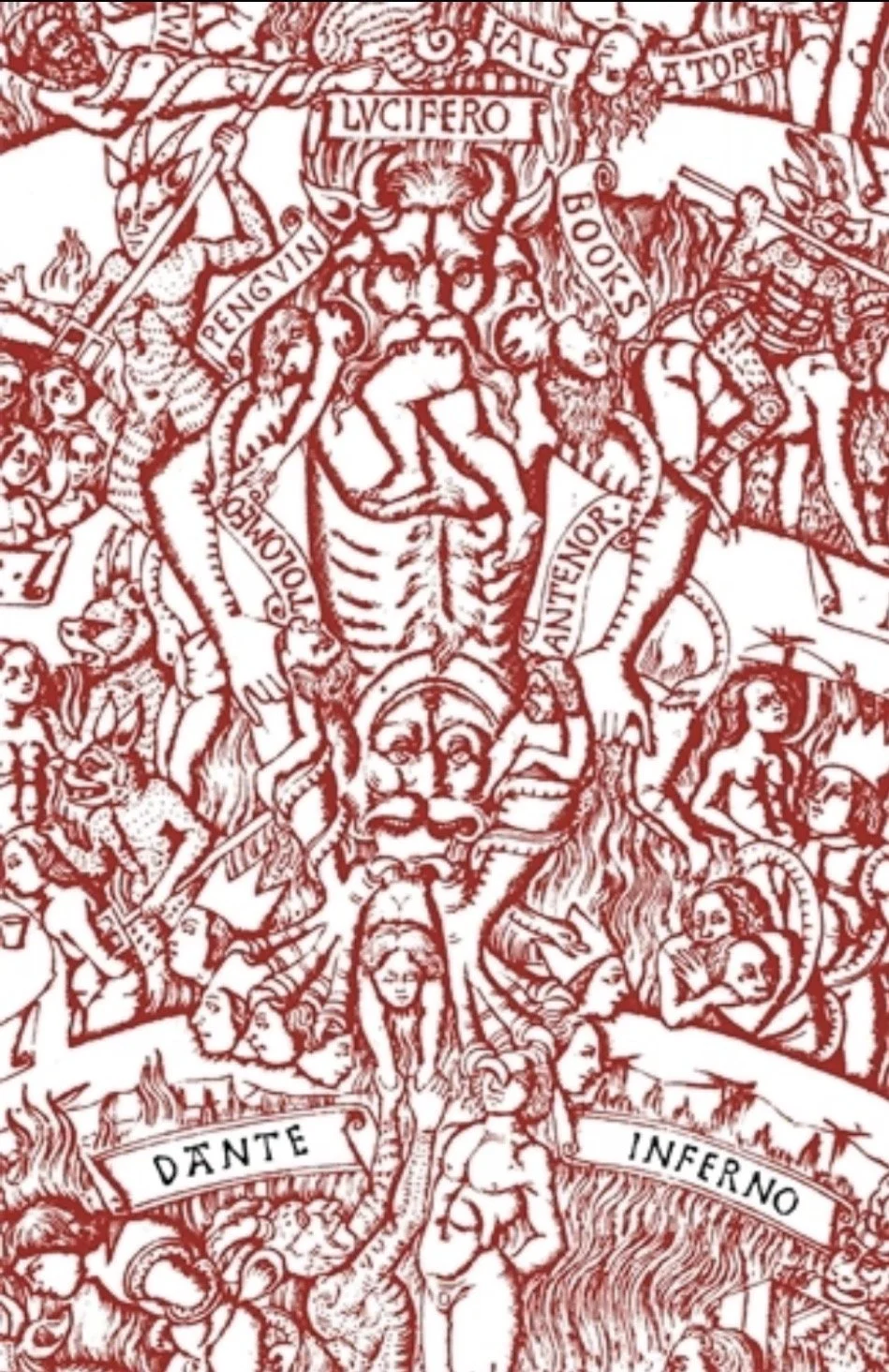
Finally, the last sinner Dante meets in Hell is Lucifer himself, who traitorously “raised his brow against his Maker.” Lucifer is both the archetypal sinner and the cause of all other sins, and the existential dread Dante feels upon seeing Lucifer causes Dante to realize the horror of sin as a rejection of divine goodness and as an action which unmakes, or destroys, the self. Fully knowing the terror of sin, Dante flees from it. Virgil helps him climb down Lucifer’s legs into a little cave, and then they walk out of the cave until they can see the moon and stars. In the medieval world, the moon and the stars represent divine truth and grace. Dante, having renounced his sin, is at last ready to perceive and move closer toward spiritual realities.
The story represents Dante learning curve of renouncing sin and sinners, but this is a slow process as Dante’s spiritual growth is hindered by his own sympathy for the sinners in Hell. He faints with sympathy for Paolo and Francesca’s tragic love story, despite the fact that their love story involved cheating on Francesca’s husband, and he bets Virgil that he can recognize a few sinners punished for their greed, despite the fact greed has made the sinners “foul . . . beyond all recognition.” The fact that Dante does not initially see these sins as serious, with far-reaching effects on human identity and well-being, recalls his spiritual confusion at the beginning of the Inferno. Clearly in need of spiritual maturity, Dante at this point relies heavily on Virgil to correct his errors and point out the consequences of sin. At the climax of the story, he looks Lucifer, the devil himself, in the face and passes by, symbolizing a readiness to leave sin behind. When he successfully emerges from Hell, Dante is ready to renounce his own sins and begin the journey nearer to God. The trip to Hell is not afterlife tourism but a spiritual rescue mission.
It’s a 4 out of 5 as it is a classic.