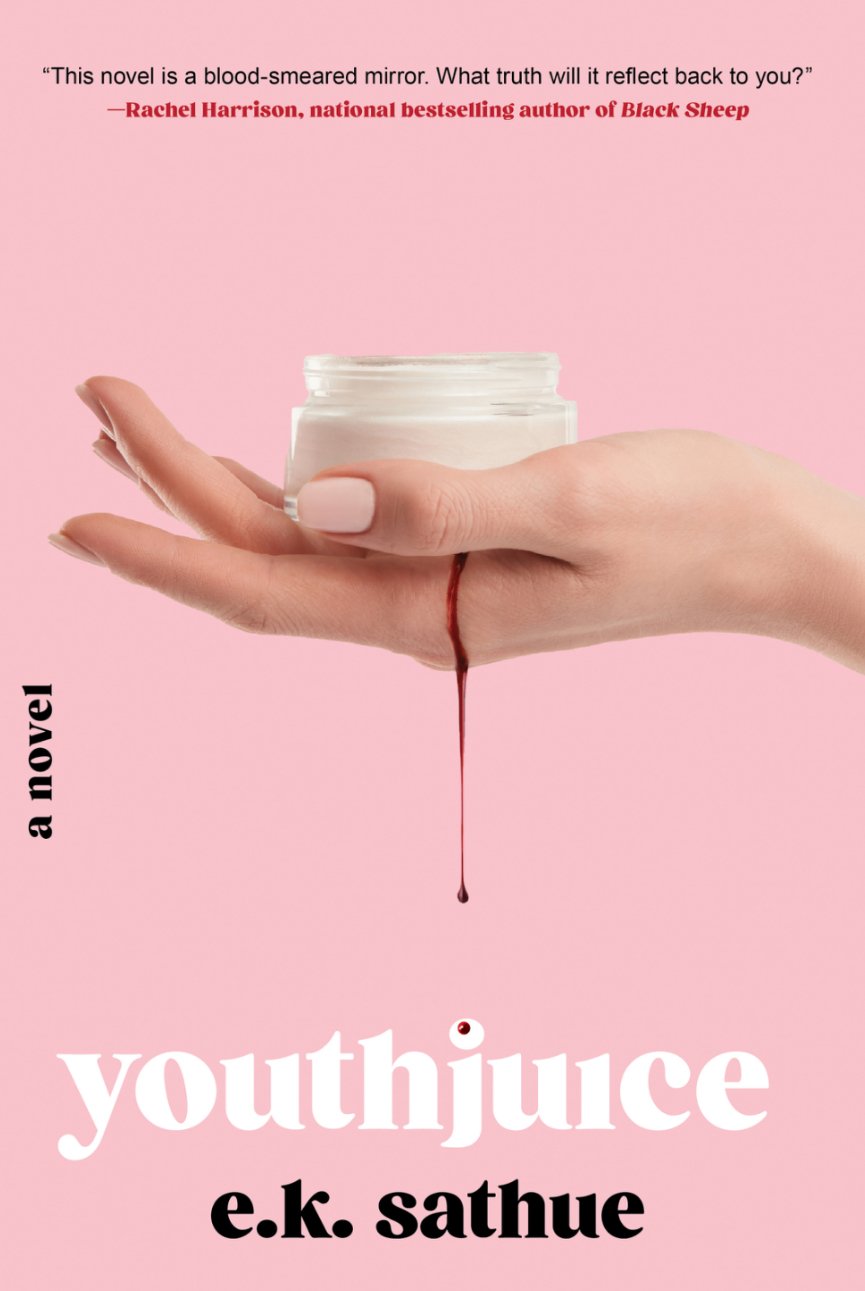
Review of Youthjuice
by E.K. sathue
Join us on Instagram to get the latest news and drops!
By H. Dwyer
***Spoilers… DUH***
I was expecting American Psycho meets The Substance but what I got was a half-arsed episode of Buffy.
The novel begins with our narrator, Sophie Bannion, who recently becomes a copywriter for a luxury skincare brand HEBE. Sophia becomes obsessed with the company’s lifestyle and magical cream that seems to heal all ailments. However, the cream is made from the sacrificial blood of young women who come to the company as interns and mysteriously disappeared. Sophie’s obsession with her boss Tree- yes Tree- leads her down a path where her boyfriend leaves her, and she kills her flat mate/ only friend Dom. Instead of drinking the Kool-Aid, Sophia slaps on the Youthjuice.
Simultaneously, Sophia looks back on her childhood relationship with Mona, who succumbs to addiction and suicidal tendencies. The past relationship with Mona tried to provide an explanation to Sophia’s difficulty forming relationships with other women. Yet, this parallel narrative was disjointed from the main storyline and provided no real depth to Sophie’s character other than that she was always insecure within herself and self-conscious around other women.
The book is that it is very much in the now but it will struggle to move on with the times. The constant reference to niche brands, like House of Sunny, to make a comment on the type of girls that are being targeted. In the future, I have no doubt that these references will be considered obscurely outdated – dare I say it “cheugy”- and this will inevitably prevent it from becoming a classic. You could say that the constant reminders of the narrator’s obsession with flighty fashion trends could a metaphorical theme that everything becomes old and out-date; not just the women but everything that surrounds them. Thereby implying that women are seen as passing entities that have a limited usefulness and their (the narrators) obsession with remaining young is futile. However, I cannot say this was the writer’s intention as the integration of these niche off-the-now references are contrived to express the difference between the narrator and the young and beautiful interns. Nevertheless, I did enjoy how Sathue uses descriptive language to paint a clear image in the reader’s mind. I could easily picture each character and place which is a credit to great writing.
Overall, its commentary of the beauty industry and women’s feelings towards aging in the presence of young women in the work environment was better demonstrated in Coralie Faregate’s 2024 film The Substance. Faregate’s film was able to mesh ideas of beauty standard pressures with body horror in such a successfully sadistic way, it shone a light on how women are perceived in not only the media but in everyday life as well. If you were looking for a book that is similar to The Substance, then I would recommend Mona Awad’s Rouge. Awad’s novel is far more precise with its language in order to drive home its point of clinging on to youth and beauty desperately in comparison Youthjuice. It is a shame as I was so excited for this book to be released that I pre-ordered it but it did not in fact live up to the incredibly high expectations.
I give this book 2.5/5. Not bad but others are better.